
Introduction
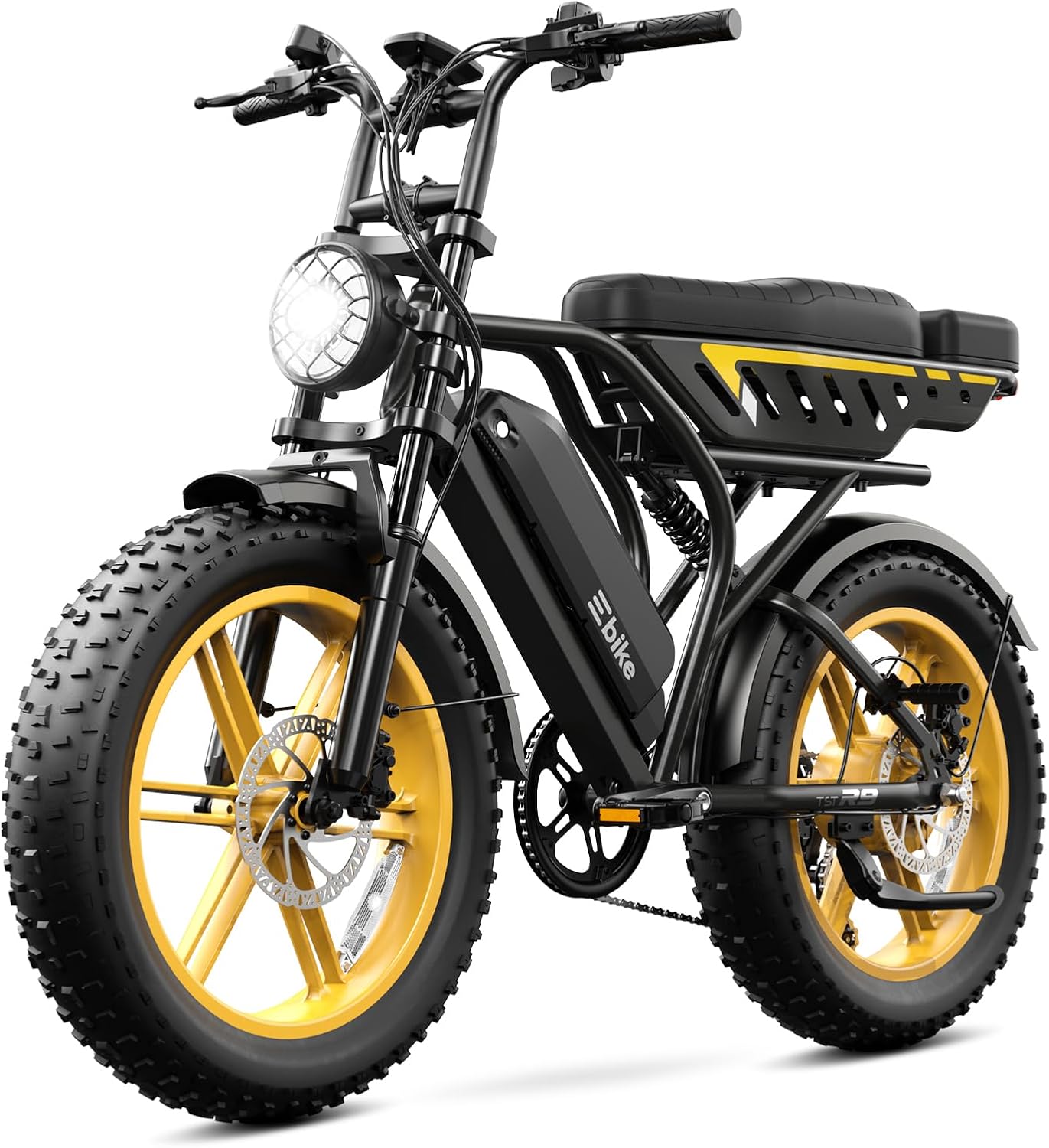
The TST Electric Bike for Adults positions itself as a do-it-all electric dirt bike: a 1500W peak motor, wide 20×4.0 fat tires, removable 48V battery in 15/30Ah options, and a claimed top speed of 28 mph. It is marketed for off-road use—sand, snow, trails—and for long-distance travel with range claims up to 130+ miles on the larger battery.
This review examines the TST through an objective lens, assessing build quality, real-world performance, safety features, and practical trade-offs. Wherever possible I contrast the manufacturer’s claims with how such specs typically translate to everyday riding scenarios.
Design & Build Quality
The frame appears to be a reinforced alloy design sized around a compact 20″ wheel platform, consistent with the bike’s “dirt bike” styling. The extended seat and integrated rear rack add utility for carrying gear and improve long-ride comfort compared with minimalist fat-bike seats.
20×4.0-inch fat tires are a defining element. These provide substantial traction and flotation on loose surfaces such as sand and snow, and they also smooth rough trails. That said, fat tires increase rolling resistance and weigh more than narrower tires, impacting pedaling efficiency and transportability.
Stopping power comes from dual mechanical disc brakes. Mechanical discs are robust and easier to maintain than hydraulic systems, but they generally offer less modulation and heat dissipation. The inclusion of 360° LED lighting—headlight, brake light and turn signals—adds a notable safety advantage for night or low-visibility riding.
The bike’s full suspension setup is a practical choice for the claimed off-road role. While specifics on travel and damping are not provided, a full-suspension layout will absorb trail chatter better than rigid or hardtail frames; performance will depend heavily on the quality of the fork and rear shock.
Performance & Range
The drive unit is rated at 1500W peak with 90 N·m of torque. In practical terms this means strong acceleration and capable low-speed torque for steep climbs. The manufacturer claims the bike can handle a 35-degree slope—an aggressive figure that suggests the motor and torque curve are tuned toward climbing. Real-world performance on steep grades will still depend on rider weight, traction, and battery charge state.
Top speed is listed as 28 mph via the app. Achieving this will require favorable conditions: charged battery, flat terrain, and throttle use. That speed places the bike at or above many jurisdictions’ e-bike speed limits for unassisted operation, so riders should check local laws before using the throttle at maximum velocity.
Battery choices—48V at either 15Ah or 30Ah—create markedly different range profiles. The product copy indicates a range of roughly 60 miles (likely representative of the 15Ah option) and more than 130 miles for the 30Ah pack. Those figures are plausible but optimistic: they assume conservative assist levels, light rider weight, flat terrain, and selective throttle use. In throttle-only operation and on mixed terrain, expect substantially lower range.
Charging time of around five hours for a full charge is competitive, particularly for a large 30Ah pack; this implies the included charger supplies relatively high current or that the 5-hour figure applies to the smaller pack. The battery is removable and claimed to be waterproof, and the system is safety-tested to UL 2849, which is a meaningful credential for electrical and battery safety on e-bikes.
Ride modes include pure electric (throttle), pedal-assist with a speed sensor, and traditional pedal-only operation. The speed-sensor-based assist will provide smoother, proportional assistance but is generally less immediate than cadence-sensor systems. The multiple modes make the bike flexible for commuting, off-road exploration, or exercise-focused riding.
Handling and braking on mixed terrain are influenced by fat tires, full suspension, and mechanical discs. The fat tires and suspension provide traction and comfort off-road, while the heavier setup and bulky tires reduce nimbleness in tight urban environments. Mechanical discs are adequate for typical trail speeds, but riders pushing the bike to its high-speed potential may notice fade over prolonged steep descents.
Who Is This Best For?
- Riders seeking a powerful, off-road-capable e-bike for sand, snow, and trails.
- Commuters who want a long-range option and the flexibility to swap between 15Ah and 30Ah batteries.
- Users who value simple, serviceable components (mechanical discs, removable battery) over boutique high-end parts.
- Recreational riders who prioritize torque and climbing ability for hilly terrain.
- People who need utility features like an extended seat and integrated rear rack for touring or cargo.
Trade-offs to Consider
- Weight and portability: Fat tires, a large battery, and full suspension add mass. Expect the bike to be heavy to lift or carry for stairs and transport.
- Range variability: The quoted 60/130-mile figures depend heavily on battery size and riding conditions; throttle-only, aggressive riding, or heavy riders will reduce range significantly.
- Braking choice: Mechanical disc brakes are dependable but offer less stopping modulation and thermal performance than hydraulic systems.
- Local regulations: A top speed of 28 mph and throttle allowance may put the bike into a higher regulatory category in some regions; you may be restricted from certain paths or require registration/insurance.
- Maneuverability: Bulky fat tires and long wheelbase reduce agility in tight city lanes or crowded paths compared with narrower urban e-bikes.
- Warranty term: A 6-month comprehensive warranty is shorter than many competitors’ 12-month or multi-year warranties, so consider aftermarket protection for long-term use.
Final Verdict
The TST 1500W fat-tire e-bike is a purpose-built, high-torque machine well suited to riders who want serious off-road capability, long-range options, and practical features like a removable UL 2849-tested battery and integrated lighting. It balances strong climbing performance and trail comfort against the expected penalties of extra weight, higher rolling resistance, and less nimble handling in tight spaces. If you need a robust electric dirt bike for exploration or utility and understand the trade-offs—particularly legal speed limits and realistic range under varied conditions—this model represents a compelling value. Check current price and availability to determine whether the battery configuration and local support match your intended use.