
Introduction
The Freego F3 Pro Max (second generation) positions itself as a high-performance electric motorcycle-style bike for adults who want motorcycle-like speed and range with the convenience of an e-bike platform. With dual brushless motors rated at a combined 2000W, a removable 48V/55Ah dual lithium-ion battery pack, 20″x4.0″ fat tires, and UL certification, the F3 Pro Max targets riders who want off-road capability and long-distance touring without a gas engine.
This review examines the Freego F3 Pro Max objectively across design, build quality, real-world performance, range, and practical trade-offs to help prospective buyers decide if it matches their needs.
Design & Build Quality
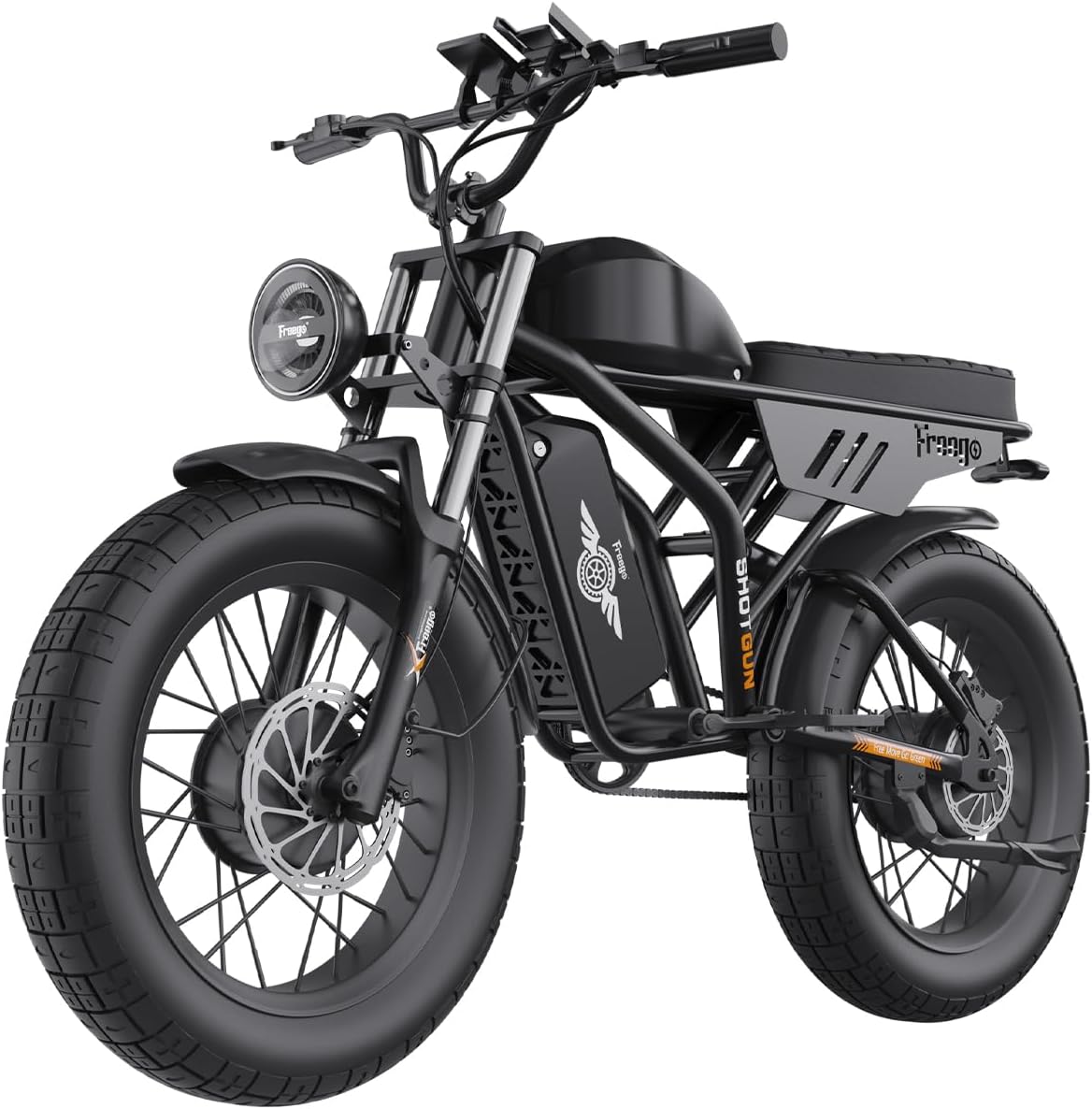
At first glance the F3 Pro Max reads as a compact dirt/motorcycle hybrid rather than a commuter e-bike. The frame and layout follow a motorcycle-inspired form factor with a stepped saddle, raised handlebars, and a low center of gravity that supports the bike’s stated 400-pound payload capacity.
Freego equips the F3 Pro Max with 20″ wheels fitted with 4.0″ fat tires. Those tires provide a large contact patch and predictable traction across sand, snow, mud, and rough urban surfaces. The wide rubber plus the dual shock absorbers front and rear mean the bike is tuned for comfort and stability rather than nimble handling in tight spaces.
Stopping power and safety received clear attention in the second-generation update. Compared with the first generation’s twin-piston calipers and 180mm rotors, the F3 Pro Max uses four-piston calipers and 203mm discs, improving braking performance and heat dissipation under load. The bike also includes bright head and tail lights and an LCD display that shows speed, battery level, and mileage.
Build quality appears solid for the class: welding, cable routing, and component fitment are consistent with mainstream production ebikes. Freego also made cosmetic and comfort upgrades to this generation — a refreshed body logo, a wider seat cushion, and updated tires — which improves perceived refinement. Note that the large battery and dual-motor hardware will make the unit significantly heavier and less portable than a folding or single-battery city ebike.
Performance & Range
The F3 Pro Max uses dual brushless motors with a combined nominal rating of 2000W. Freego claims a top speed of 34 MPH in Sports mode and a torque figure of up to 85 Nm, which gives the bike strong acceleration and the ability to climb steep grades (manufacturer states up to a 40° slope under ideal conditions).
Power delivery is selectable by riding mode. The bike’s three-mode system produces distinct performance and range outcomes: Eco Mode (single motor, ~15 mph) is optimized for range; Standard Mode (~25 mph) engages both motors for sustained performance; Sports Mode (~34 mph) prioritizes top speed. Those mode claims come with the manufacturer’s range figures: Eco ~103 miles, Standard ~70 miles, and Sports ~55 miles on the 48V/55Ah dual-battery configuration.
Two points about those range numbers are important. First, the 103-mile figure is tied to Eco Mode and single-motor operation; it assumes relatively mild conditions, moderate rider weight, and limited auxiliary loads. Second, real-world range depends heavily on rider weight, terrain, speed, wind, tire pressure, and how often you use throttle versus pedal assist. Expect sizable reductions from the headline numbers if you regularly ride in Standard or Sports mode, carry cargo, or tackle hilly terrain.
Suspension and braking systems are tailored to handling the bike’s weight and speed. Twin shocks smooth rough surfaces well, and the upgraded four-piston hydraulic discs provide confident stopping power even with higher demands. The removable dual lithium-ion battery design is convenient for charging and for swapping batteries, but it also contributes to the bike’s bulk and weight.
Certification-wise, Freego states the model has a GCC test report and UL (UL 2849) certification. Those certifications indicate the bike’s electrical system and battery management have been tested to standardized safety criteria, which is a notable plus for a high-capacity e-bike in this power class.
Who Is This Best For?
- Riders who want motorcycle-like acceleration and top speed without gasoline and licensing hassles in permissive jurisdictions.
- Off-road or mixed-terrain enthusiasts who need fat tires and strong suspension for sand, snow, or rough trails.
- Commuters or tourers who prioritize extended range and portability of a removable dual-battery setup (for long day trips between recharge opportunities).
- Heavier riders or two-up situations where a high payload capacity (up to 400 lbs) and robust brakes are beneficial.
- Buyers who value factory electrical safety testing (UL 2849 certification) for peace of mind with high-capacity battery systems.
Trade-offs to Consider
- Weight and maneuverability: The dual motors and large 55Ah battery make the bike heavy. This reduces ease of maneuvering at low speeds, carrying, or storing the bike compared with lighter e-bikes.
- Local regulations: A 34 MPH top speed places the F3 Pro Max into a legal gray area in many jurisdictions. Check local e-bike and motor-assisted vehicle laws — you may need registration, insurance, or a license to operate at higher speeds.
- Real-world range variability: Manufacturer range figures are optimistic and based on ideal conditions. High speeds, hilly terrain, and heavy loads will shorten range significantly.
- Charging time and infrastructure: Large-capacity dual batteries will take longer to charge, and the charger’s power rating controls how long that takes. Freego does not publish a definitive charge-time in the product copy, so expect several hours per battery for a full charge.
- Portability and storage: The bike’s bulk and non-folding frame make it less suitable for multi-modal commutes or tight storage spaces.
- Service and parts availability: As with many niche high-power e-bikes, local dealer/service breadth can be limited. Plan for the possibility of shipping parts or arranging specialized service for motor or battery work.
- Delivery logistics: Due to package weight, the bike and accessories often arrive in two shipments. This can delay full assembly and initial rides if packages arrive on different days.
Final Verdict
The Freego F3 Pro Max is a purpose-built, high-capacity electric dirt/moto-bike that delivers impressive power, long advertised range, and strong braking and suspension for its class. Its dual-motor, dual-battery architecture and UL certification are meaningful advantages for riders who want extended range and confidence in electrical safety. However, the bike’s size, weight, regulatory implications at high speed, and realistic range limitations make it most suitable for experienced riders who prioritize range and off-road capability over portability.
If you want a robust, motorcycle-like electric ride with long-range potential and you can accommodate its physical and legal trade-offs, the F3 Pro Max is worth investigating further — check current price, battery and charging details, and local regulations before you buy.