
Introduction
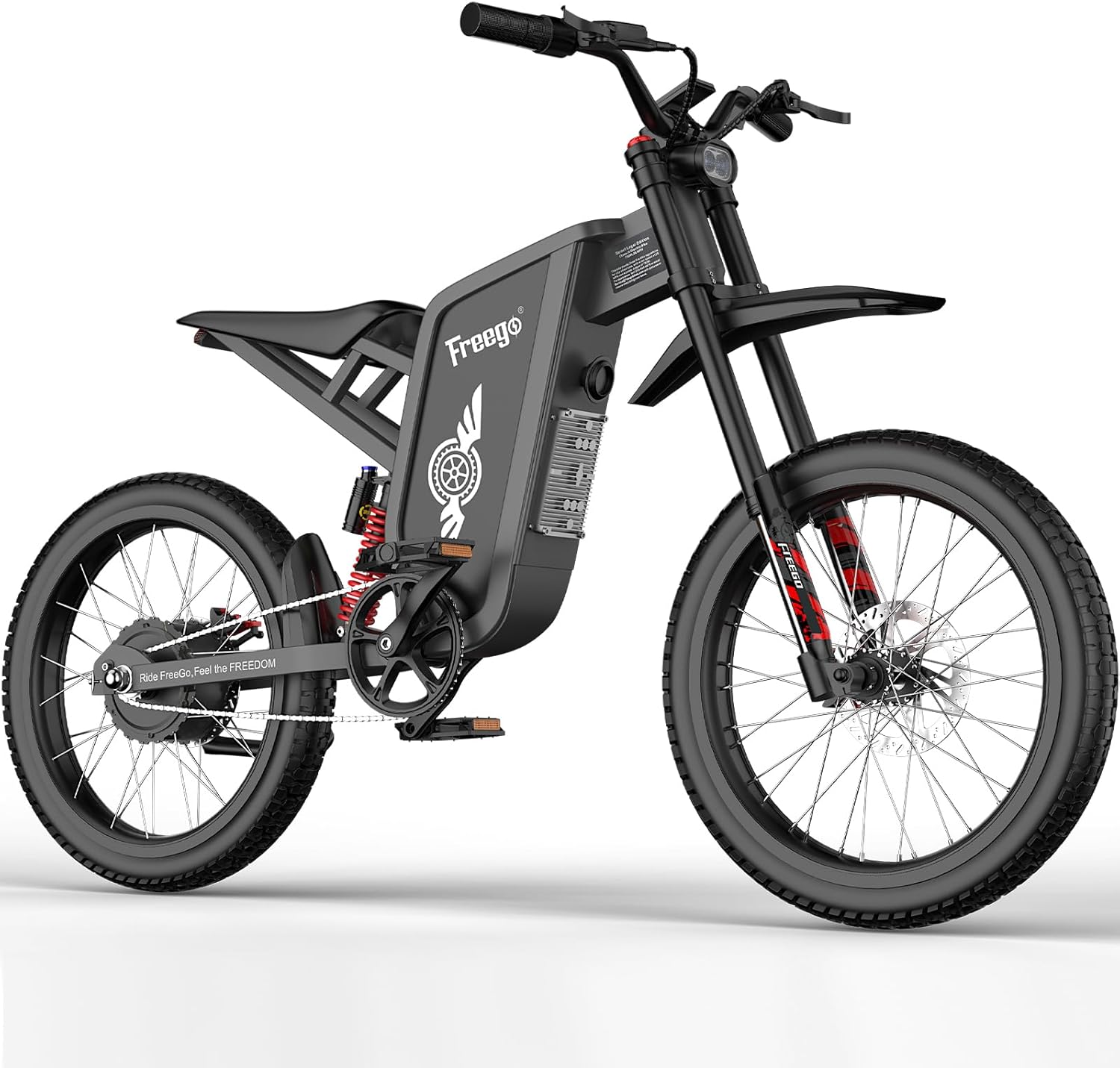
The Freego X1 is an electric dirt bike aimed at adults and larger teens who want a high-torque, off-road-capable e-bike with motorcycle-like performance. It pairs a 1500W nominal (3000W peak) hub motor with a 60V/25Ah battery, a full-suspension chassis, and motorcycle-grade braking and spokes. This review examines how those specifications translate into ride quality, real-world range, durability, and practical trade-offs for prospective buyers.
Design & Build Quality
Frame and ergonomics
The X1 uses a high-strength steel frame rather than the aluminum used on some sibling models. Freego reports this adds about 3 kg but improves flexibility and mechanical resilience for rough terrain. The seat has been thickened and lowered, with an 81 cm (32.67 in) seat height, making mounting easier for riders in the 5’6″–6’4″ (167–193 cm) range.
The overall ergonomics are focused on off-road use: half-twisted throttle for better grip, non-slip rubber grips to reduce sweat slippage, and an adjustable, wider seat for longer rides. These changes are incremental but meaningful for comfort on extended trail sessions.
Tires, wheels and suspension
The X1 rides on 17 x 1.6″ tires mounted on motorcycle-grade spokes. The choice of 17″ rims with relatively narrow 1.6″ tires reflects a compromise—sufficient for hard-packed trails and mixed surfaces, but narrower than fat-snow or sand-specific tires would be for loose sand or deep mud.
Suspension is described as improved over previous models and paired with full suspension front and rear, which helps absorb trail chatter and jumps. In practice this setup should be adequate for typical trail riding; extreme motocross-style use will expose limitations typical of e-bikes in this price class.
Braking and controls
The X1 uses a four-piston hydraulic brake system with 203 mm rotors, which is a clear upgrade over dual-piston systems and provides strong stopping power at higher speeds. Brake lever ergonomics are improved for easier modulation.
Controls include an M5 display that shows speed, battery level and trip mileage, plus a magnetic pedal-assist sensor that engages assistance as soon as you start pedaling. A fan-cooled charger is included to help manage charging heat. Overall component selection suggests a focus on durability and user control rather than minimal weight.
Performance & Range
Motor, torque and speed
The motor is rated at 1500W continuous with a 3000W peak and a quoted 150 N·m maximum torque. In practice that combination delivers brisk acceleration and the ability to climb moderate grades while carrying a rider and light cargo.
Freego specifies a top “Off-road mode” speed of up to 37 MPH (≈60 km/h). Achieving and sustaining that speed depends on rider weight, terrain and legal or electronic limits. This places the X1 closer to moped-class performance than typical commuter e-bikes.
Battery capacity and real-world range
The battery is a 60V, 25Ah pack (1,500 Wh). Real-world range for powerful, off-road focused bikes varies widely with throttle use, terrain, rider mass and selected assistance mode.
Conservative and realistic estimates: in aggressive off-road use or continuous high-power riding, expect a lower range in the 20–30 mile (32–48 km) band. On mixed use with moderate assistance and pedaling, mid-range riders may see 30–50 miles (48–80 km). These ranges are indicative, not guaranteed, and will fall closer to the lower end during steep climbs or high-speed runs.
The included fan-cooled charger helps with battery thermal management. The manufacturer does not publish an exact charge time in the material provided here; typical charging times for similar 60V/25Ah packs are several hours (commonly 4–8 hours) depending on charger current.
Handling and ride quality
At moderate speeds the X1 handles predictably thanks to the steel frame and full suspension. The motorcycle-grade spokes and four-piston brakes contribute to a planted feel and confidence under braking.
Because the frame and battery make this a relatively heavy machine compared with lightweight commuter e-bikes, low-speed maneuvering and carrying the bike are more cumbersome. On open trails and straight-line sections the bike rewards with strong acceleration and stable tracking.
Who Is This Best For?
- Off-road enthusiasts who want near-moped performance in an e-bike package for trails and fire roads.
- Riders needing high torque for climbing and hauling; the 150 N·m torque rating helps in technical sections.
- Commuters who want ruggedness and the ability to handle unpaved links or long camp-commute routes.
- Adult riders and taller teens in the 5’6″–6’4″ height range satisfied by the lowered, thicker seat and ergonomic controls.
- Buyers who prioritize braking and component quality—the four-piston hydraulic brakes and motorcycle-grade spokes are notable advantages.
Trade-offs to Consider
- Weight and maneuverability: The steel frame and large battery make the X1 heavier than many e-bikes, reducing low-speed agility and making transport and lifting harder.
- Legal and regulatory complexity: With 3000W peak and a 37 MPH top speed in off-road mode, legal classification varies by jurisdiction—check local laws for registration, licensing and where it can be ridden.
- Tire choice limits some terrain: The 17 x 1.6″ tires are versatile but narrower than fat tires, so expect reduced flotation in deep sand or very soft surfaces.
- Range sensitivity to riding style: Real-world miles depend heavily on throttle usage, rider mass, and terrain; expect a wide variance from marketing figures.
- Shipping logistics: The product may arrive in two packages if overweight, which can cause staggered delivery or require coordination to receive both parts.
Final Verdict
The Freego X1 is a well-specified electric dirt bike that leans toward performance and durability rather than ultralight portability; its 1500W/3000W motor, 60V/25Ah battery, motorcycle-grade brakes and steel frame make it a compelling option for riders seeking higher speed and torque in trail environments. The trade-offs are predictable—added weight, terrain limits from narrower tires, and the need to verify legal classification—so prospective buyers should weigh how much they value raw capability versus everyday practicality. If you prioritize off-road acceleration, braking confidence and a robust build, the X1 merits serious consideration; check the current price and availability to determine whether it fits your budget and local regulations.