
Introduction
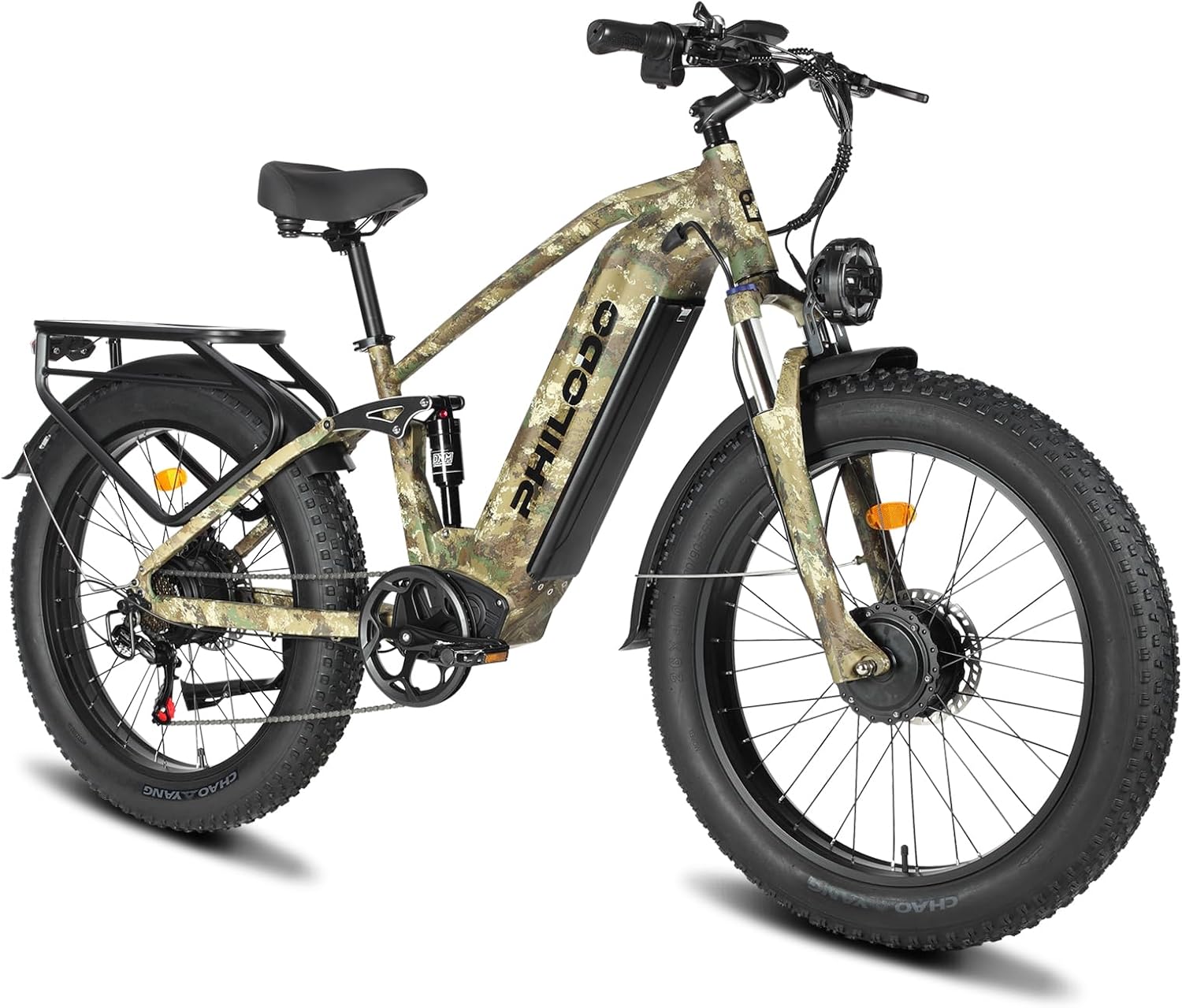
The PHILODO 5000W Dual Motor e-bike positions itself as a high-power, all-terrain electric mountain bike aimed at riders who want off-road capability and high top speeds. It combines dual brushless motors, a high-voltage 60V battery pack, full suspension, and 4″ fat tires to deliver a package that bridges dirt-bike performance and an electric bicycle form factor.
This review takes an objective look at design, components, real-world performance expectations, practical trade-offs, and who will get the most value from this platform. Where the manufacturer provides claims, I note them and contrast with realistic rider expectations.
Design & Build Quality
The frame appears to follow the modern e-fat-bike geometry: a beefy downtube to house wiring and battery mounts, wide chainstays to accept large tires, and reinforced welds around high-stress junctions. The overall finish and hardware are consistent with mid-to-upper tier mass-market e-bikes, though long-term corrosion and fatigue resistance depend on material grade and manufacturing tolerances.
Suspension is a focal point: a lock-out front fork combined with an air-adjustable rear shock (DNM-style) gives riders a broad tuning range. The lock-out option is useful for road riding where pedaling efficiency matters, while the DNM air spring lets heavier riders or aggressive off-road users dial in sag and rebound.
Tires are genuine fat-bike spec at approximately 4 inches wide (listed as 26/24 x 4). Those big treads increase flotation and traction on sand, snow, and loose surfaces. The seller highlights triple-layer protection—puncture-resistant casing, water draining features, and shock absorption—traits that suit rough-terrain use but also add rotational mass.
Braking is handled by hydraulic disc calipers front and rear. Hydraulic discs are the appropriate choice for a 5000W-capable e-bike given the braking forces involved, and they provide more consistent modulation and fade resistance than mechanical discs.
Performance & Range
Powertrain: The bike uses two brushless hub motors rated at a combined 5,000W (2 × 2,500W). In practice that delivers strong low-end torque for acceleration and steep climbs. The bike is also configurable to run in single-motor mode for better efficiency or dual-motor mode for maximum performance.
Top speed: The product literature lists a “45 Mile P-Hour” figure, which reads as a claimed top speed near 45 mph. That is exceptionally fast for an e-bike and exceeds legal limits in many jurisdictions. Expect top speed to vary by configuration (single vs dual motor), rider weight, slope, and local limiting software.
Battery & range: A 60V 32Ah battery is specified, which is a high-capacity pack relative to consumer e-bikes. Manufacturer estimates range at roughly 50–100 miles per charge depending on riding mode, terrain, and rider mass. Real-world results for a heavy, high-power dual-motor setup usually cluster toward the lower end of that range when using aggressive power settings; using pedal-assist or single-motor modes extends mileage.
Charging time and management: The battery is listed with a 10–12 hour recharge time using the supplied charger. That is typical for large-capacity packs but means multi-day heavy use requires spare batteries or long downtimes. A real-time battery level display is included, which is useful for range management on longer trips.
Handling & ride quality: The full-suspension layout and fat tires provide a forgiving ride off-road and increased confidence on rough trails. However, the combination of suspension travel, large tires, and a heavy battery/motor package increases overall weight, which affects low-speed maneuverability, carrying, and transport.
Who Is This Best For?
- Riders seeking a high-power, off-road capable e-bike for sand, snow, and rugged trails.
- Commuters who need long single-charge range and intend to use eco or single-motor modes for efficiency.
- Experienced e-bike users who understand local regulations and are comfortable with higher speeds and heavier bikes.
- Recreational riders who prioritize traction and ride smoothness in adverse surfaces (beaches, snowfields, loose dirt).
- Those who want a versatile platform with multiple riding modes (dual/single motor, PAS, cruise, walk assist).
Trade-offs to Consider
- Weight: Dual motors, a 60V 32Ah battery, and robust suspension make this a heavy bike. Expect lifting, storing, and transporting to be challenging compared with lighter e-bikes.
- Legal and insurance implications: Claimed top speeds and motor power exceed typical e-bike classifications (often limited to 750W or ~20–28 mph). Check local laws; this bike may be classified as a motor vehicle in many areas and could require registration, insurance, or be restricted from bike paths.
- Maneuverability: Fat tires and mass reduce nimbleness in tight singletrack and urban traffic; turning radius and quick-direction changes will feel more ponderous.
- Range variance: Real-world range is highly dependent on mode selection, terrain, and rider behavior. Using dual-motor full-power mode will significantly reduce the advertised maximum range.
- Charging time: A 10–12 hour recharge means you need planning for multi-day trips; fast-charging options are not standard and may stress battery longevity.
- Assembly & support: The bike ships ~85% assembled and includes tools and video instructions, but final setup (brake bleed, torque checks, suspension tuning) may require a competent mechanic for optimal safety and performance.
- Maintenance complexity: Two motors, hydraulic systems, and an air shock increase service needs and potential repair points versus simpler hub-motor single-motor designs.
Final Verdict
The PHILODO 5000W Dual Motor e-bike is a compelling choice for riders who prioritize raw power, flotation on soft terrain, and a comfortable full-suspension ride. Its 60V 32Ah battery and twin 2,500W motors promise strong acceleration and long-distance potential, while fat tires and adjustable suspension make it well suited for snow, sand, and rough trails.
That capability comes with important trade-offs: substantial weight, long recharge times, higher maintenance complexity, and potential regulatory restrictions due to power and speed. For experienced riders who understand those limitations and plan to use the bike off-road or in permissive jurisdictions, it offers considerable value as a high-performance, all-terrain e-bike. If you’re interested, check the current price and availability, and verify local rules before purchasing.