
Introduction
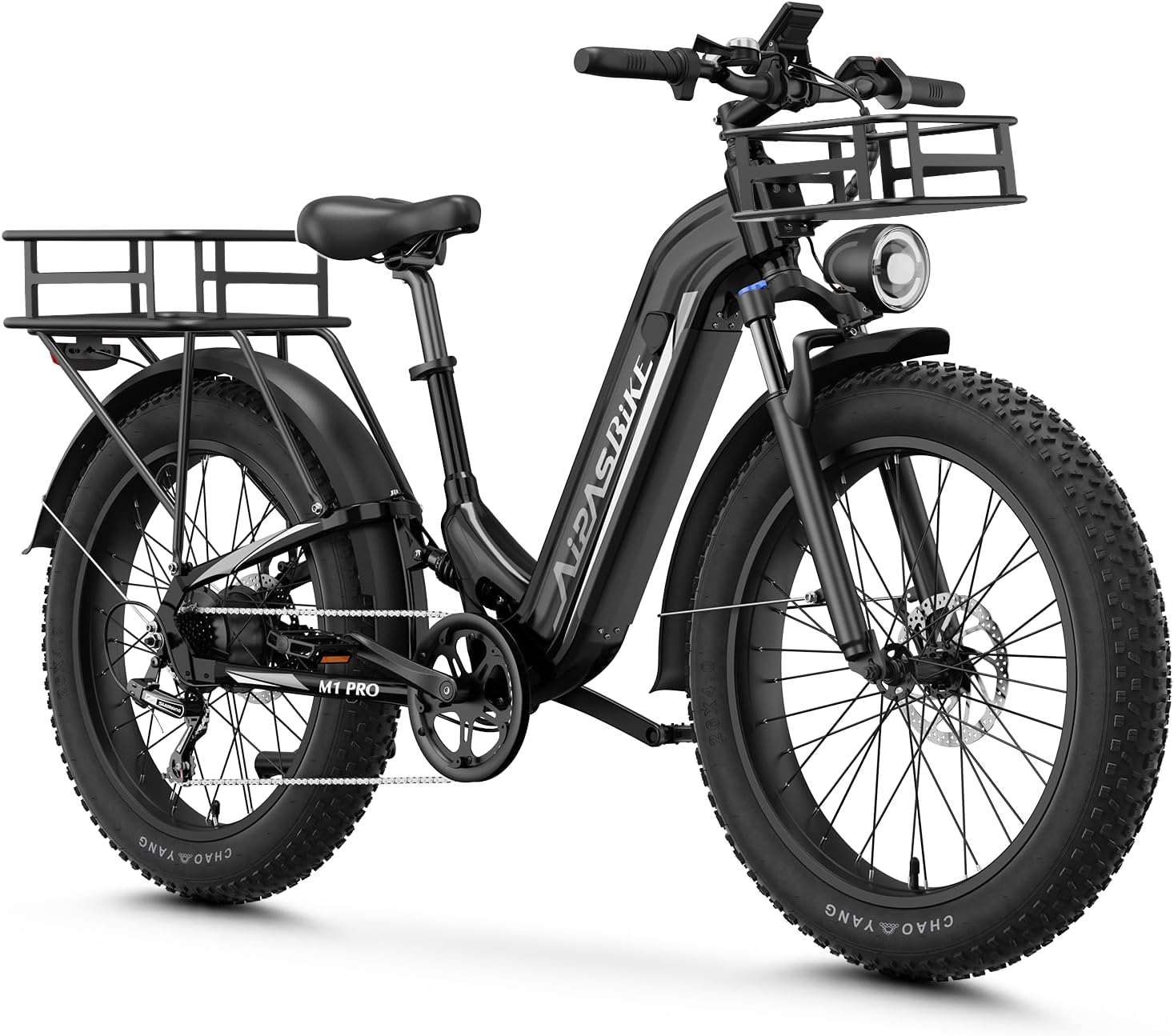
The Aipas M1 Pro Electric Bike is positioned as a high-power fat-tire e-bike built for riders who want a mix of commuting practicality and off-road capability. With an 1800W peak motor, a 48V 17.5Ah removable battery, and a claimed top speed of 36 MPH, it targets users who want more than a basic city cruiser. It also adds a step-thru frame, dual suspension, and a rear basket, which makes it more versatile than many performance-focused e-bikes.
On paper, this is the kind of bike that tries to cover a wide range of needs: daily transportation, weekend trail riding, hauling light cargo, and longer-distance cruising. That broad appeal is one of its biggest strengths, but it also means buyers should evaluate whether its size, speed, and features match their actual riding environment. The M1 Pro looks best suited to riders who want power and comfort in one package, rather than a minimalist or lightweight commuter.
Design & Build Quality
The Aipas M1 Pro uses a step-thru frame, which immediately makes it more approachable than many traditional mountain-style e-bikes. Getting on and off is easier, especially for riders who may have mobility limitations, wear everyday clothing, or simply prefer a less awkward mount. The brand recommends it for riders between 5’5″ and 7’2″, suggesting a fairly broad fit range, though comfort will still depend on inseam and riding posture.
The 26″ x 4.0″ fat tires are one of the defining design features. They give the bike a more planted stance and help absorb some surface irregularities, especially on gravel, sand, packed dirt, and uneven pavement. Fat tires can also improve confidence in slippery conditions, although they typically add rolling resistance and contribute to the bike’s overall heft.
Dual suspension is another meaningful design choice here. The lockable front fork and rear shock absorber should help smooth out rough roads and light trail use better than a rigid commuter bike. That said, suspension quality on e-bikes in this price and category can vary widely, so the real value depends on how well the components are tuned and maintained over time.
The included rear basket adds utility, making the bike more useful for errands or carrying small items. Combined with the step-thru frame and upright-friendly design, this makes the M1 Pro feel less like a niche off-road machine and more like a practical all-purpose electric bike. The trade-off is that these features usually increase weight and reduce the compactness that some riders may want for apartment storage or car transport.
Performance & Range
The headline performance feature is the 1800W peak brushless motor, paired with 110Nm of torque. That is a substantial amount of assist for a consumer e-bike and should provide strong acceleration, especially from a stop or when climbing hills. The stated climbing ability of up to 23° suggests it should handle steep neighborhoods and moderate trail gradients reasonably well.
In real-world terms, a motor like this is best understood as giving the bike a broad comfort zone rather than making it effortlessly extreme in every condition. Rider weight, terrain, wind, tire pressure, and battery state all affect how the bike feels, so the advertised 36 MPH top speed may not be consistent in every scenario. Still, the motor spec indicates it is designed to feel responsive and capable under load.
The 48V 17.5Ah removable battery is another major strength. The claimed range of 25 to 85 miles is wide, which is common because battery range changes significantly depending on pedal assist level, speed, terrain, and throttle use. A more realistic expectation is that heavy throttle use and high speeds will reduce range sharply, while moderate pedal assist on flatter routes can extend it considerably.
For commuters, the battery size is promising because it offers the possibility of fewer charging cycles during the week. For recreational riders, it also supports longer rides without immediate range anxiety. The removable design is practical, since it allows charging indoors and may be more convenient for riders who do not have easy access to an outlet near storage.
The bike’s 7-speed drivetrain adds flexibility, especially when the motor is being used in combination with pedal assist. That can help riders manage hills more efficiently and gives some control when battery power is lower. The five riding modes—Throttle, Pedal Assist, Cruise, Normal, and Walk—further broaden its usefulness, though not every rider will use all modes regularly.
Braking and handling are important on an e-bike with this level of power, and the M1 Pro uses 180mm mechanical disc brakes. Mechanical discs are generally easier to service than some hydraulic systems, and they provide dependable stopping power for everyday riding. However, because the bike can reach relatively high speeds and likely carries extra weight from the battery, motor, tires, and frame, buyers should be realistic about braking demands, especially on descents or in wet conditions.
The smart LCD display is a welcome feature because it keeps the main ride data visible at a glance. Speed, distance, battery level, and mode information are useful in everyday use and make the bike feel more complete. The built-in USB charging port is also practical for riders who want to top up a phone or small device while riding, although it should be viewed as a convenience feature rather than a high-output charging solution.
Overall, the M1 Pro appears designed to deliver strong all-around performance rather than niche specialization. It should be capable on city streets, gravel paths, and casual trail routes, with enough power to make longer commutes feel manageable. Its real appeal is the combination of high motor output, large battery capacity, and comfort-oriented hardware in a single platform.
Who Is This Best For?
- Commuters who want a powerful e-bike with enough range for daily travel and occasional detours.
- Riders who prefer a step-thru frame for easier mounting and dismounting.
- Heavier riders or hill riders who benefit from the motor’s high torque and climbing support.
- Casual off-road users who want fat tires and suspension for gravel, dirt, or mixed terrain.
- Errand runners who can make use of the rear basket and removable battery.
- Longer-distance recreational riders who value a larger battery and multiple assist modes.
Trade-offs to Consider
- Weight is likely substantial, which can make lifting, storing, or transporting the bike more difficult.
- 36 MPH capability may exceed local e-bike regulations in some areas, so buyers should check laws before riding.
- Fat tires and suspension improve comfort but can reduce efficiency compared with lighter commuter bikes.
- Mechanical disc brakes are functional, though not necessarily as refined as hydraulic brakes on higher-end models.
- The claimed range is highly variable and may be much lower with throttle-heavy riding or high speeds.
- The bike’s size may feel bulky in tight storage spaces or crowded urban environments.
- High power can be overkill for casual riders who only need short, low-speed neighborhood trips.
Final Verdict
The Aipas M1 Pro stands out as a versatile, power-forward electric bike that blends strong motor output, a large removable battery, fat-tire stability, and comfort-focused features like a step-thru frame and dual suspension. It is most compelling for riders who want one bike that can handle commuting, light cargo, and mixed terrain without feeling underpowered. If those priorities match your needs, it is worth checking the current price and availability to see whether the specification-to-value balance fits your budget.