
Introduction
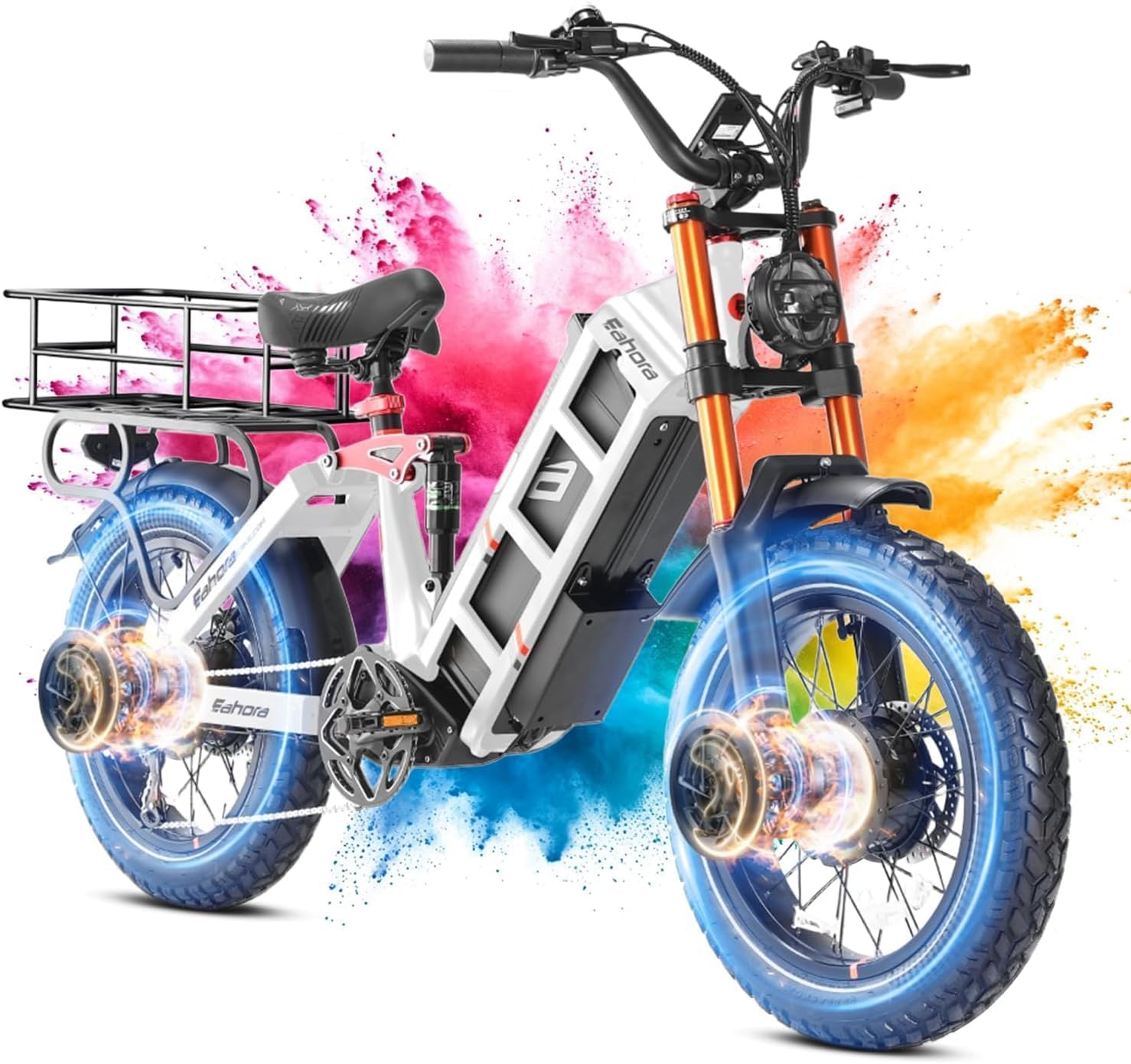
The eAhora Juliet Pro II is positioned as a high-performance dual-motor electric bike aimed at riders who want motorcycle-like speed, long-distance range, and off-road capability. The manufacturer markets it with bold claims: a peak 5400W dual-motor system, a large 70Ah battery pack, full suspension, fat tires, and features such as smart app control and cruise control.
This review examines those claims, assesses real-world usability, and highlights what prospective buyers should consider before committing to a substantial and specialized e-bike purchase.
Design & Build Quality
At a glance the Juliet Pro II follows the contemporary fat-tire, full-suspension e-bike aesthetic: stout aluminum frame, long travel front fork, and a four-link rear suspension. The frame is reported to be aluminum and rated for a maximum rider load of 400 lbs, which is robust compared with many consumer e-bikes.
The bike ships with 20″ x 4.0″ puncture-resistant fat tires designed for stability across mixed terrain. Fat tires plus the suspension package should provide a forgiving ride on gravel, snowmelt tracks, and rough dirt trails. The inclusion of a lockable, adjustable front fork and a four-link rear suspension indicates a focus on ride comfort and adjustability.
Stopping power is addressed with 4-piston dual hydraulic disc brakes, which are a higher-spec braking system compared with single or dual-piston calipers commonly found on mid-range e-bikes. Lighting includes a 2000-lumen headlight and a tail light with brake signal, improving visibility in low-light situations.
Build quality is hard to fully verify without long-term testing, but the bike comes roughly 85% pre-assembled, includes tools and manuals, and carries a 1-year motor/battery warranty plus a 2-year frame warranty. These service terms are typical for direct-to-consumer e-bikes and provide a basic level of after-sales support.
Performance & Range
Performance claims are the centerpiece of the Juliet Pro II marketing. The bike is advertised with a peak 5400W dual-motor figure and a quoted top speed of up to 43 MPH. The listing references two high-output motors and dual controllers intended to deliver strong acceleration and hill-climbing torque.
There are some inconsistencies in published specs (e.g., the product name and copy reference both 60V and 52V components). For clarity, treat the quoted power and top speed as manufacturer claims rather than independently verified laboratory results.
Range is another headline feature: the bike uses a very large 70Ah battery (60V in some text), with a claimed PAS range between 120–220 miles. In principle, a battery pack on the order of thousands of watt-hours (several kWh) could produce very long ranges in low-assist conditions, but real-world range varies dramatically based on speed, terrain, rider weight, assist level, and use of both motors.
Expectations for a machine capable of 30–43 mph should be tempered. At higher speeds and when using both motors aggressively, energy draw rises sharply and range will drop well below peak claims. A more realistic expectation across mixed riding would be a wide range depending on riding style: long-distance touring at low PAS may approach the higher end of the claim, while fast dual-motor riding will substantially reduce range.
Handling considerations follow from the bike’s hardware: the fat tires and full suspension will smooth rough surfaces but add rolling resistance and mass. The bike will feel stable at speed in a straight line, but its mass and wide tires make it less nimble in tight urban maneuvers compared with lighter commuter e-bikes.
Electronics include an LCD display with USB charging port, multiple ride modes (throttle, pedal-assist, walk mode), cruise control, and a brake-to-start safety feature. The unit also advertises smart app control and map navigation, which can be useful for trip planning and monitoring ride data if the software is well implemented.
Who Is This Best For?
- Experienced riders seeking high top speed and strong hill-climbing capability for off-road or mixed-terrain adventures.
- Long-distance e-bike touring riders who prioritize battery capacity and the possibility of extended rides between charges.
- Riders who need a cargo-capable platform (included rear rack) and high payload tolerance (up to 400 lbs).
- Users who value suspension performance and robust braking for aggressive riding and steep descents.
- People comfortable with larger, heavier electric bikes and the maintenance/charging logistics of high-capacity battery packs.
Trade-offs to Consider
- Weight and size: A dual-motor, large-battery fat-tire e-bike will be significantly heavier and bulkier than standard e-bikes, affecting transport, storage, and lifting.
- Legal and safety considerations: Top speeds in the 30–43 mph range exceed most e-bike legal limits in many jurisdictions; riders should check local laws regarding motor power, throttle use, licensing, insurance, and helmet requirements.
- Range variability: The 120–220 mile range claim depends heavily on conservative riding and single-motor PAS. High-speed dual-motor use will reduce range considerably.
- Maintenance and parts: Dual motors, high-capacity battery, and full suspension increase maintenance complexity and potential repair costs versus simpler single-motor setups.
- Charging time and infrastructure: A very large battery will require longer charge times and potentially dedicated charging strategies if you plan to exploit full range frequently.
- Maneuverability: Fat tires and a long wheelbase reduce agility in tight urban spaces and on crowded bike paths.
Final Verdict
The eAhora Juliet Pro II is a purpose-built, high-performance electric bike that prioritizes speed, battery capacity, and off-road capability. Manufacturer claims for a peak 5400W dual-motor system and a 70Ah battery producing up to 120–220 miles of range present a compelling specification sheet, but real-world performance will depend heavily on riding conditions, assist mode, and how often both motors are used.
For experienced riders who need long range, high payload capacity, and robust suspension/braking—and who accept the trade-offs in weight, legality, and maintenance—the Juliet Pro II offers a compelling, feature-rich package. Prospective buyers should verify local regulations, clarify the exact electrical specifications with the seller, and check current price and availability before purchasing.