
Introduction
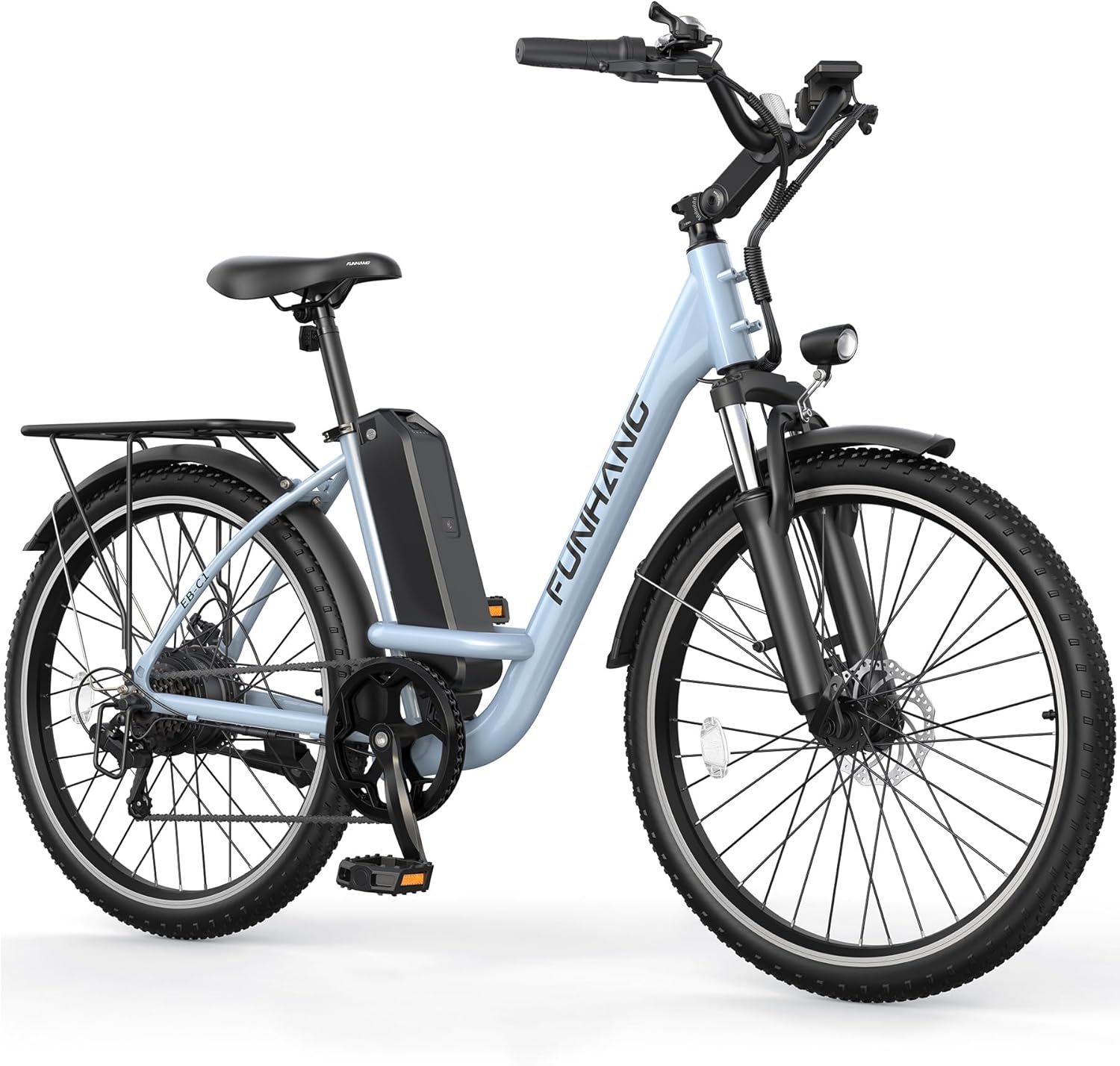
The Funhang EB-C1 26″ City Cruiser is marketed as a versatile urban e-bike that blends commuter practicality with recreational capability. It pairs a 500W nominal (1000W peak) rear hub motor and a removable 48V 374.4Wh battery with a step-thru frame, front suspension, and a 7-speed drivetrain.
This review examines the bike’s design, components, real-world performance, intended riders, and notable trade-offs, using the manufacturer’s specifications and practical considerations for everyday use.
Design & Build Quality
The EB-C1 uses a step-thru frame to simplify mounting and dismounting, a clear plus for riders who prioritize convenience over an aggressive riding position. The listing does not explicitly state the frame material, so buyers should confirm if it is aluminum alloy — the common choice at this price point — before assuming corrosion resistance or stiffness characteristics.
Tires are 26″ city/cruiser size, which strikes a balance between rollover capability and agility in urban environments. The bike includes full fenders and a sturdy-looking rear rack, which add utility for commuting and errands without needing aftermarket accessories.
Component transparency is mixed. The bike features a 7-speed gear system and 160mm disc brakes front and rear, but the specific brands and whether the brakes are mechanical or hydraulic are not listed. The front fork suspension will soften bumps on uneven pavement, though the spec sheet doesn’t give travel or damping details, indicating it is likely a basic coil fork rather than a high-end suspension unit.
Ergonomics are adjustable: the stem tilt can change handlebar height by about 30 degrees (handlebar height range 39.37″–43.30″), and the saddle height adjusts from 32.48″–39.76″. These ranges suit many riders and contribute to a comfortable, upright riding posture.
Performance & Range
The electric drivetrain is the EB-C1’s headline feature. It uses a 500W continuous motor rated at 1000W peak with a claimed maximum torque of 55 Nm. The motor can push the bike to the advertised top speed of 20 mph (32 km/h), which is typical for consumer e-bikes intended for mixed urban riding.
Acceleration from a standstill and hill-climbing on moderate grades should be strong thanks to the motor’s peak output and the 7-speed gearing. The bike also offers a “booster” mode and a throttle for low-speed push-assist or pure-electric operation, useful for starting on hills or when carrying cargo.
Range is governed by the removable 48V, 374.4Wh battery. Manufacturer estimates are 25–30 miles on pure throttle and 40–50 miles with pedal assist. Those figures are reasonable for a battery of this capacity, but real-world range will vary with rider weight, average speed, assist level, terrain, temperature, and stop-and-go city riding.
The bike’s LCD display offers PAS (pedal-assist) levels 1–5, speed, mileage, and battery state, which makes it straightforward to manage power use while riding. IPX5-rated battery protection is a useful detail for occasional wet-weather use, though IPX5 is resistant to water jets rather than full submersion.
Stopping power relies on 160mm disc brakes at both wheels. Without clarity on whether these are mechanical or hydraulic calipers, expect competent but not exceptional braking — adequate for city speeds but something to verify in a test ride, especially when carrying loads on the rear rack.
Who Is This Best For?
- Urban commuters who want a comfortable, upright riding position and a step-thru frame for easy mounting and cargo loading.
- Riders who need a multi-purpose e-bike with a rear rack and fenders for groceries, light cargo, or commuting gear.
- Casual cyclists looking for throttle and pedal-assist flexibility, including cruise and booster modes for convenience on mixed terrain.
- Riders between approximately 5’3″ and 6’1″ (manufacturer recommended) seeking a mid-range e-bike with a claimed 300 lb payload capacity.
- Buyers who value safety certifications: the EB-C1 cites UL 2271 (battery) and UL 2849 (complete e-bike) recognition.
Trade-offs to Consider
- Weight and portability: The listing does not specify curb weight, but 48V batteries and a 500W motor typically add significant mass. Expect a heavier bike that is less convenient to lift into trunks or up stairs.
- Component detail is limited: Key parts such as frame material, brake type (mechanical vs hydraulic), and drivetrain brand/quality are not specified. That makes long-term reliability harder to judge without hands-on inspection.
- Local regulations: A 500W nominal / 1000W peak motor may exceed legal power limits in some jurisdictions, and throttle use can affect whether the bike is classified as a bicycle or a motor vehicle. Check local e-bike laws before purchase.
- Range variability: The advertised 40–50 mile PAS range assumes conservative assist use and favorable conditions; high assist, frequent stops, heavy loads, or uphill routes will reduce that range substantially.
- Assembly and setup: The bike ships ~85% preassembled, which is convenient, but final assembly still requires mechanical competence. Incorrect setup of brakes, wheels, or the electrical system can affect safety and performance.
- Suspension and brakes likely basic: The front suspension and 160mm discs sound good on paper, but without details on damping and caliper type they may be more comfort-oriented than performance-oriented.
Final Verdict
The Funhang 26″ EB-C1 City Cruiser presents a compelling package for riders seeking a comfortable, utility-focused e-bike with a strong motor, removable 48V battery, step-thru frame, and practical accessories like a rear rack and fenders. Its UL certifications and multiple riding modes add confidence and versatility for daily commuting and recreational rides.
However, limited specification details for some key components, potential weight concerns, and local regulatory limits on motor power mean prospective buyers should weigh the bike’s strengths against their specific needs and verify unanswered technical questions before buying. If the combination of range, ease-of-use, and utility matches your priorities, check the current price and availability to determine whether the EB-C1 offers the best value for your area and riding style.