
Introduction
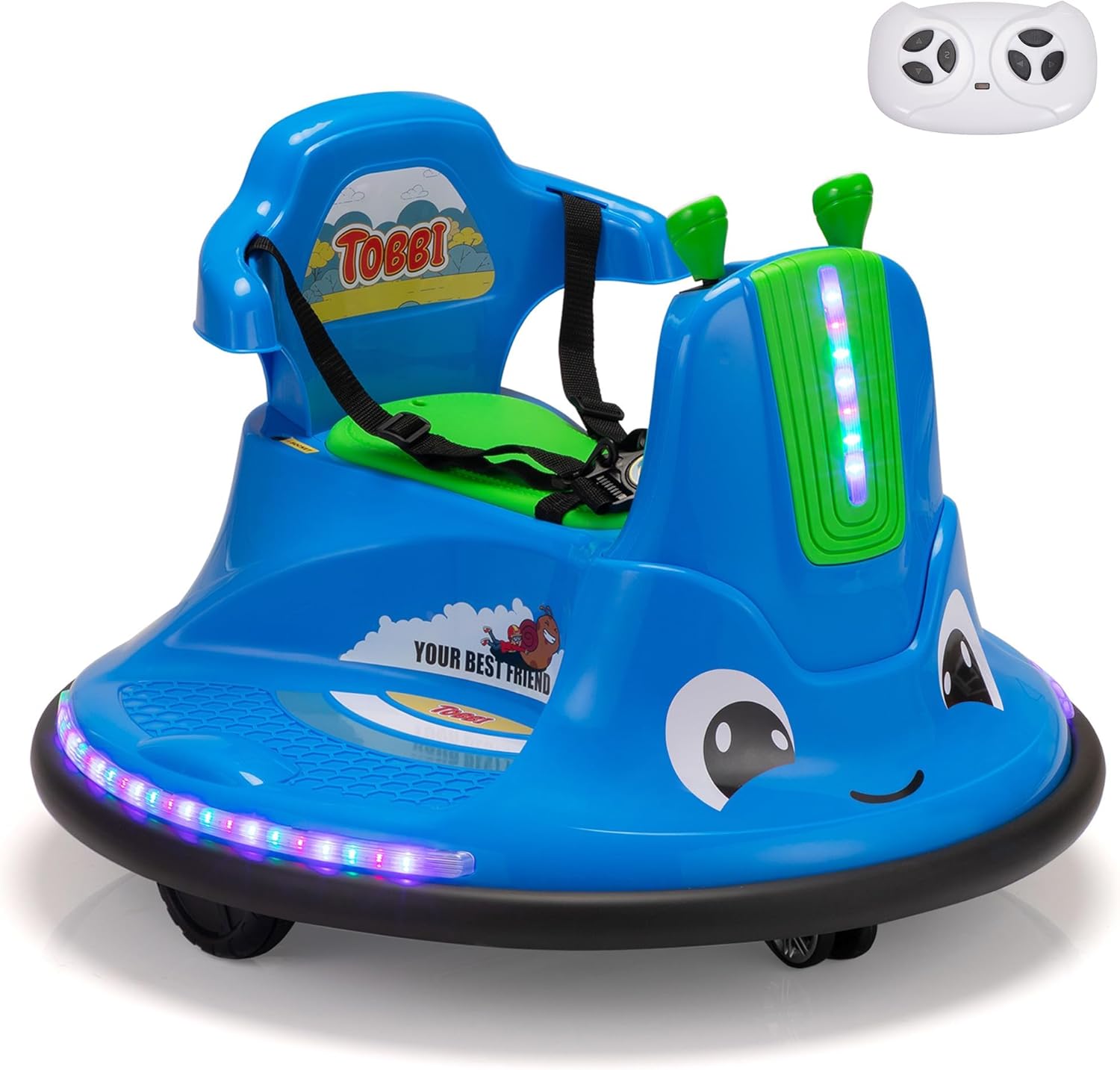
The TOBBI Kids Electric Ride On Snail Shape Toy is designed less like a traditional ride-on car and more like a playful mobility toy for very young children. Its snail-inspired body, flashing lights, music, 360-degree spinning action, and included stickers give it a strong novelty factor, while the parent remote control and 12V battery-powered system add a layer of practical supervision. For families looking for an indoor- or smooth-surface bumper-style ride-on, it offers a different experience from the usual car or truck-shaped options.
At a high level, this product appears to prioritize fun, safety, and ease of use over speed or complex mechanics. TOBBI positions it as a toy that can grow with a child, offering remote control for younger toddlers and independent driving for older preschoolers. That dual-mode approach is one of its most important selling points, especially for parents who want a ride-on toy that can remain useful beyond the first stage of ownership.
It is also worth noting that this product is clearly aimed at the younger end of the ride-on market. With an age range of roughly 1 to 6 years, it is best understood as a toddler bumper car with personality, rather than a rugged outdoor vehicle. In that category, it competes on charm, control, and child-friendly features more than raw performance.
Design & Build Quality
The most distinctive feature of this TOBBI ride-on is its snail-shaped design. That shape helps it stand out immediately, and for many families the visual appeal will be a major part of the purchase decision. The rounded body also fits the bumper-car concept well, since the toy is meant to absorb light contact rather than behave like a precise steering vehicle.
Construction details suggest that safety and soft-impact play were central to the design. The product description highlights a 4-point seat belt and a soft rubber bumper strip, which are both useful for keeping a child seated and reducing the harshness of bumps into furniture or other riders. These are sensible features for a toy intended for younger children who are still developing coordination and judgment.
The inclusion of ASTM certification is an important confidence point, since it suggests the toy complies with recognized U.S. safety standards. That does not make it risk-free, of course, but it does indicate that the product is not purely decorative or novelty-focused. Parents should still supervise play, particularly with children near the bottom of the age range.
Assembly is described as relatively simple, with fewer loose parts than many comparable toys. That is a practical advantage because ride-on toys can be frustrating to set up, especially when parents are dealing with large components, unclear instructions, or battery installation challenges. A quick setup also means the toy is more likely to be used immediately, which matters with younger kids whose excitement can be short-lived.
The overall build appears well matched to its purpose: a low-speed, bump-friendly indoor ride-on. It is not presented as a premium vehicle with advanced suspension or heavy-duty wheels, and buyers should not expect that level of engineering. Instead, the build quality is focused on accessible fun, a friendly appearance, and child-safe operation.
Performance & Range
Because this is a 12V battery-powered toddler bumper car, its performance profile is primarily about controlled movement rather than long-distance driving. The available information emphasizes features such as 360-degree spinning, bumping, lights, and music, all of which contribute to an interactive play experience. For the target age group, these features are likely more important than speed.
The two-mode setup is one of the strongest functional elements. In remote-control mode, parents can steer the vehicle for younger children aged 1 to 3, or even younger in some cases, which helps reduce the challenge of early driving skills. In manual mode, children ages 3 to 6 can take over and explore the toy independently, which extends the product’s usefulness as a child grows.
The remote-control option is especially valuable for families with very young riders. It allows adults to correct direction, avoid obstacles, and guide the toy in a safer way during early play. This also makes the product more approachable for toddlers who are not yet ready to understand steering, braking, or spatial awareness.
As for range, the product details provided do not include a precise battery runtime or charging duration, so expectations should remain conservative. In practical terms, 12V ride-on toys typically offer enough playtime for short sessions rather than all-day use, and that is likely the case here as well. Parents planning for extended outdoor use should verify the manufacturer’s stated runtime before purchasing.
The toy’s motion is best understood as playful and compact, not powerful. That makes it suitable for flat indoor floors, patios, or smooth driveways, but less suitable for rough terrain, steep slopes, or uneven surfaces. The lack of detailed suspension information suggests that comfort over bumps may depend more on the soft bumper design than on any sophisticated ride system.
In real-world use, the ride-on’s value comes from engagement: lights, music, spinning, and the novelty of the snail shape all encourage repeated play. This is the kind of toy that can entertain a child through sensory stimulation as much as through movement. That balance is particularly effective for toddlers, who often respond more to visual and auditory feedback than to speed alone.
Who Is This Best For?
- Families with toddlers aged 1 to 3 who want a parent-controlled ride-on that can be used before independent driving skills develop.
- Children ages 3 to 6 who are ready for a simple manual ride-on and enjoy bumping, spinning, and interactive features.
- Parents looking for a safer bumper-style toy with a seat belt and soft exterior rather than a more exposed electric vehicle.
- Gift buyers who want something visually memorable and playful, especially for birthdays or holidays.
- Families who value indoor-friendly entertainment and have smooth floors or other suitable riding surfaces.
- Households that prefer supervised play and appreciate the ability to take control with a parent remote.
Trade-offs to Consider
- Limited real-world range and speed: This is a toddler toy, not a performance-oriented ride-on, so expectations should stay modest.
- Surface limitations: It is likely best on smooth indoor or paved surfaces and may not perform well on grass, gravel, or rough terrain.
- Short-term novelty risk: The snail design and lights are appealing, but some children may outgrow the novelty once the sensory features become familiar.
- Age-range mismatch potential: Very young children will need close supervision, while older children near age 6 may find it small or less exciting.
- Battery dependence: Like most electric ride-ons, playtime will be limited by charging needs, which can interrupt longer sessions.
- Not a high-speed ride-on: Buyers expecting a more car-like or adventurous driving experience may find the bumper-car format too tame.
Final Verdict
The TOBBI Kids Electric Ride On Snail Shape Toy is a thoughtfully designed toddler bumper car that stands out for its friendly appearance, parent remote control, safety-focused features, and dual-mode usability. Its strongest appeal lies in how it combines supervised play for younger children with independent riding for older preschoolers, making it a versatile option for families who want a single toy to cover multiple developmental stages. If you are looking for a charming, safety-conscious, and easy-to-use ride-on rather than a fast or rugged electric vehicle, this model is worth a close look—especially if you want to compare the current price and availability before buying.