
Introduction
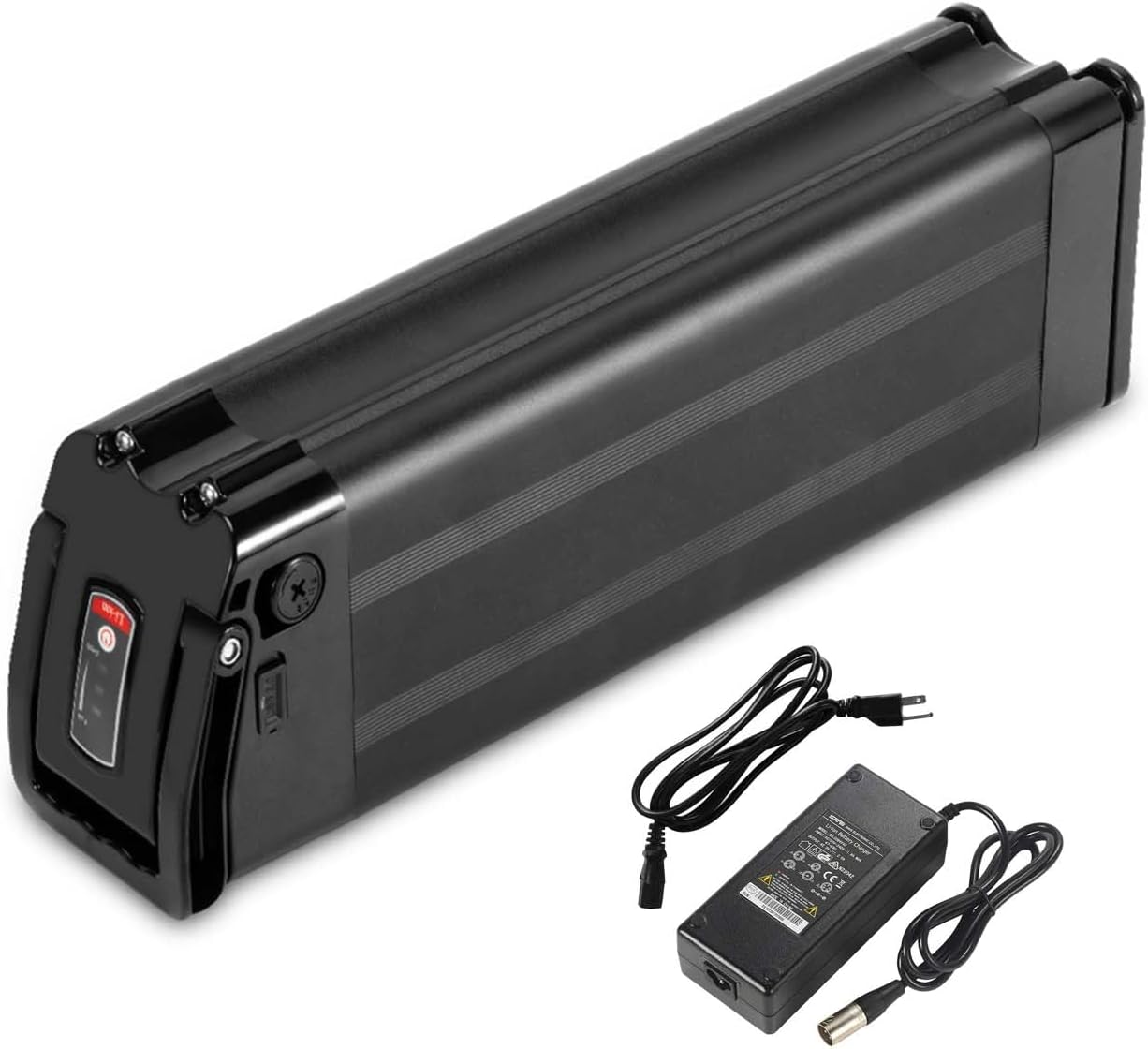
The Yose Power 36V 15Ah e-bike battery is one of several lithium battery options offered by Yose Power, a manufacturer and supplier of e-bike power systems since 2011. This review focuses on the black 36V/15Ah variant listed for 0–1000W motor compatibility and evaluates its design, build, performance expectations, and practical trade-offs for riders considering an aftermarket battery replacement or upgrade.
Design & Build Quality
The battery follows the common “sliver fish” frame-mounted enclosure used for many aftermarket e-bike packs. The manufacturer advertises a built-in lock, a status indicator light, and a keyed mount for easy on/off and theft deterrence, plus an external power button that briefly illuminates the state LEDs.
The listing gives physical dimensions (case tall 390 mm; listed as 14 × 3 × 4.3 inches in one spot), and a 2-pin discharge port for the motor connection. These measurements and port types are important for fitment to existing mounts, but the listing contains inconsistent values, so confirming fit against your bike’s holder before purchase is advisable.
Internally, Yose Power advertises built-in BMS protections (overcharge, over-discharge, over-current/short, and temperature protection). The product pages reference different cell types and counts across variants (e.g., 2600, 3500, and 21700 references), but the specific cell model for the 36V15Ah pack is not clearly called out in the listing.
Overall, the external construction appears functional and consistent with budget-to-midrange aftermarket packs: keyed mount, plastic casing, and a visible status indicator. The presence of a BMS and lock are positive but do not replace formal certification or independent safety testing documentation, which is not specified in the listing.
Performance & Range
Capacity-wise, a 36V 15Ah pack stores roughly 540 Wh of energy (36 V × 15 Ah). That energy figure allows reasonable range estimates when combined with expected power consumption on an e-bike.
Range depends heavily on motor power, rider weight, terrain, and assist level. As a practical estimate, conservative consumption figures commonly used for mid-drive and hub-assisted e-bikes are:
- 10–15 Wh/km for pedal-assisted, flat terrain — estimated range ~36–54 km (22–34 miles).
- 20–30 Wh/km for mixed riding or heavier loads — estimated range ~18–27 km (11–17 miles).
- 30–40+ Wh/km for high-speed or throttle-only use with powerful motors — estimated range ~13–18 km (8–11 miles).
These are general guides; real-world results will vary. If you use a powerful motor aggressively (e.g., sustained high power from a 750W or 1000W motor), expect energy draw and range to fall toward the lower end of those estimates.
Compatibility and continuous current capability are the most important technical points. The listing contains conflicting current specifications: it references a built-in 30A BMS yet also lists a “standard discharge current: 10A” and “max current: 20A.” That inconsistency matters because continuous current determines whether the battery can safely supply high-power motors.
At 36V, a 20A continuous current equates to 720W peak draw (36V × 20A), while a 30A rating would allow up to about 1,080W. If the pack’s true continuous capability is 10–20A, that effectively limits it for sustained use on motors rated above ~700–800W, especially during climbs. For intermittent bursts a higher-rated motor might work, but doing so risks overheating or tripping protective limits.
Charging is another practical consideration: the listing states the charger is not included. Charge time will depend on the charger current you choose — for example, a 2A charger on a 15Ah pack will take roughly 7–8 hours to full charge, while a 3–4A charger will be proportionally faster. Use a charger matched to the pack voltage (nominal 36V, full charge ≈ 42V) and the manufacturer’s recommended current to preserve battery life and safety.
Who Is This Best For?
- Riders who need an economical replacement or spare pack for a 36V e-bike that uses a frame-mounted “sliver” battery.
- Commuters who want moderate range (roughly 20–40 km per charge depending on conditions) and typically use pedal-assist rather than continuous high-throttle power.
- Users located in the USA who value faster local shipping and access to a US service center, as indicated by Yose Power’s US warehouse listings.
- DIY e-bike owners comfortable verifying electrical specs, connectors, and mechanical fit before installation.
- Riders using low-to-mid-power motors (nominal continuous draw under ~20A) or who will not push sustained high current for long climbs or high-speed throttle riding.
Trade-offs to Consider
- Specification ambiguity: Conflicting current and physical dimension values appear in the listing. Confirm continuous current rating and exact dimensions with the seller before buying.
- Connector type: The pack uses a 2-pin discharge connector — not all e-bikes use that standard, so adapter cables or re-wiring may be needed.
- No charger included: You must purchase an appropriate 36V charger separately, which adds cost and requires correct voltage/current matching.
- Possible current limit for high-power motors: If the pack’s real continuous rating is 10–20A, it may not support sustained use with 750–1000W systems without thermal or BMS intervention.
- Weight and handling: Battery weight is not specified in the listing. Frame-mounted packs of this capacity are typically heavy and can affect bike handling, especially on small frames.
- Certification and long-term reliability: No independent certification (UL or equivalent) or detailed cell model is listed for the 36V15Ah variant, which makes long-term safety and cycle-life predictions less certain.
- Fitment and compatibility: The pack claims compatibility with several brands but specifically notes it cannot replace Hey Bike systems. Verify key/mount and electrical compatibility for your bike.
Final Verdict
The Yose Power 36V 15Ah pack is a pragmatic, feature-oriented replacement/upgrade option for riders who need a frame-mounted battery with a keyed lock, basic BMS protections, and reasonably sized capacity (≈540 Wh). It offers solid value for moderate-assist commuting and general-purpose riding where sustained high currents are not required, and the US warehouse option is a practical convenience for domestic buyers. That said, specification inconsistencies around continuous current, cell type, and dimensions warrant direct seller confirmation before purchase — especially if you plan to pair the battery with a high-power motor or have tight mount tolerances. Check the current price, detailed specs, and availability from the seller to ensure this pack matches your bike’s electrical and mechanical requirements before proceeding.